
portfolio

Flatform System
Year 2025
Course Composizione 2
Timeline 6 months
Professor Lorenzo Damiani
Design starts with critical observation of existing objects, guided by a Castiglionian curiosity—observe, understand, and reinterpret what already works. Before acting, gather a reference archive of objects with intrinsic intelligenceand transform them into coherent, concrete solutions.
Flatform is a modular, configurable furniture system based on transforming planar elements into three-dimensional structures. The project explores how a flat surface can gain rigidity and function through simple cutting and folding operations.
The system uses low-carbon steel blanks, laser-cut and folded, with small material removals along fold lines to ease fabrication and create 3D elements from flat sheets. Modules attach to vertical rails, allowing free spatial configurationand system adaptation over time.
The Archive
Small intelligences
The project began with the creation of an archive of everyday objects. Around twenty items with simple yet effective construction solutions were selected and studied through direct manipulation and analytical boards to understand their structure and function.
Cardboard display cases were produced to house the analysis boards, forming an organized, consultable physical archive. This process helped identify transferable construction principles for the design.


From 2D to 3D
Creased cardboard
Among the analyzed objects, cardboard folding was identified as a key construction principle, able to transform a flat surface into a rigid three-dimensional structure.
This principle was applied to the Flatform system through a change in scale and material, reinterpreting cutting and folding logics on metal sheets.


The system is based on 2D metal sheet modules, laser-cut with incisions and material removals that define fold lines and functions. Once folded, the elements gain structural rigidity. The transformation from flat surface to three-dimensional component forms the core construction principle of the system.
The System
Modules
The modules take on different functions depending on the cuts made in the metal sheet before folding. The system includes standard configurations such as shelves, coat racks, display supports, and containers, while also allowing the design of custom, personalized modules.

Shelf
For small objects and books.

Tool rail
For kitchen tools and utensils.

Coat rack
For your jackets.

Plant pot holder
For plant pots.

Organizer
For your objects.

Glass rack
For stemmed glasses.
Display
For books and magazines.
Rails and Rack
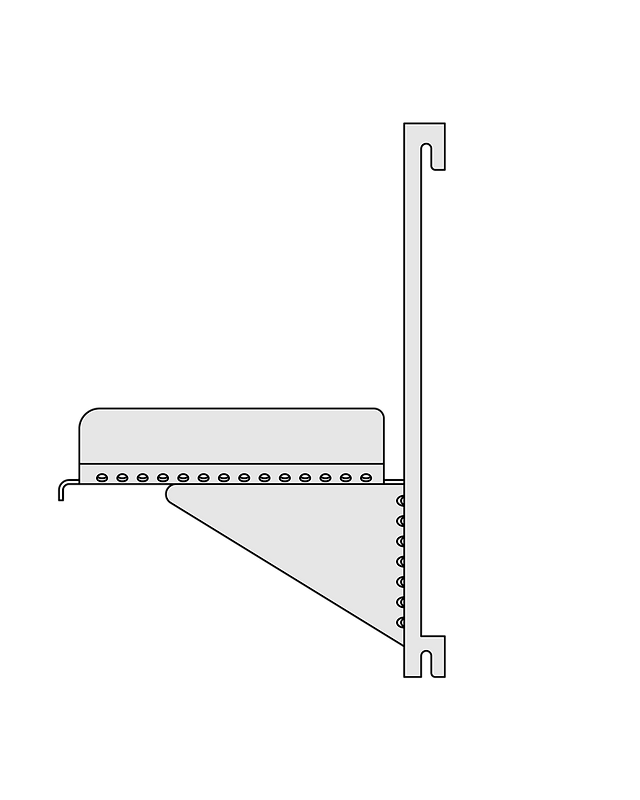
Structural folds stiffen the modules while integrating the attachment system. Laser cuts and folds create a rack mechanism that slots into vertical rails, allowing modules to be mounted and repositioned easily, securely, and without screws.

Fixing
The rails can be attached directly to the wall, mounted on a spacer profile, or installed under compression between floor and ceiling, enabling the system to be used even away from walls.
incomplete web page